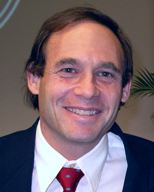
Peter H. Siegel
Founding Editor-in-Chief:
IEEE
Journal of Microwaves
Senior Scientist Emeritus: Division of
Biology (11 years)
Senior Research Scientist:
Jet Propulsion Laboratory (26 years)
Founder: JPL Submillimeter Wave Advanced Technology (SWAT)
Founder/CEO of THz Global, an international collaborative
research consulting team working on a wide variety of THz
research and applications
Founder and Current Elected General Secretary
International Society of Infrared, Millimeter, and
Terahertz Waves
(IRMMW-THz)
Founding Editor-in-Chief, IEEE
Transactions on
Terahertz Science and Technology
B.A. Astronomy, 1976, Colgate University,
Hamilton, NY
M.S. Physics, 1978, Columbia University, NY
Ph.D. Electrical Engineering, 1983, Columbia University,
NY
Nat. Res. Council Post-Doctoral Fellow, 1984, NASA Goddard
Institute for Space Studies
Email contact phs AT caltech DOT edu
Research in Millimeter-, Submillimeter-Wave and Terahertz Technology and Applications: Earth and Space Science, Biology, Medicine, Defense and related Civilian opportunities
To view Dr. Siegel's current research and his former research group .
Link to the International Society of Infrared, Millimeter and Terahertz Waves
Link to the Kenneth J Button Prize Nomination Form
Link to the IRMMW-THz Society Young Scientist Award Form
Link to 39th
International Conference on Infrared, Millimeter and
Terahertz Waves held at
University of Arizona, Tucson from September 14th-19th,
2014.
Link to 33rd
International Conference on Infrared, Millimeter and
Terahertz Waves held at Caltech from
September 15-19, 2008.
| Link to IEEE Transactions on Terahertz Science and Technology |  |
|
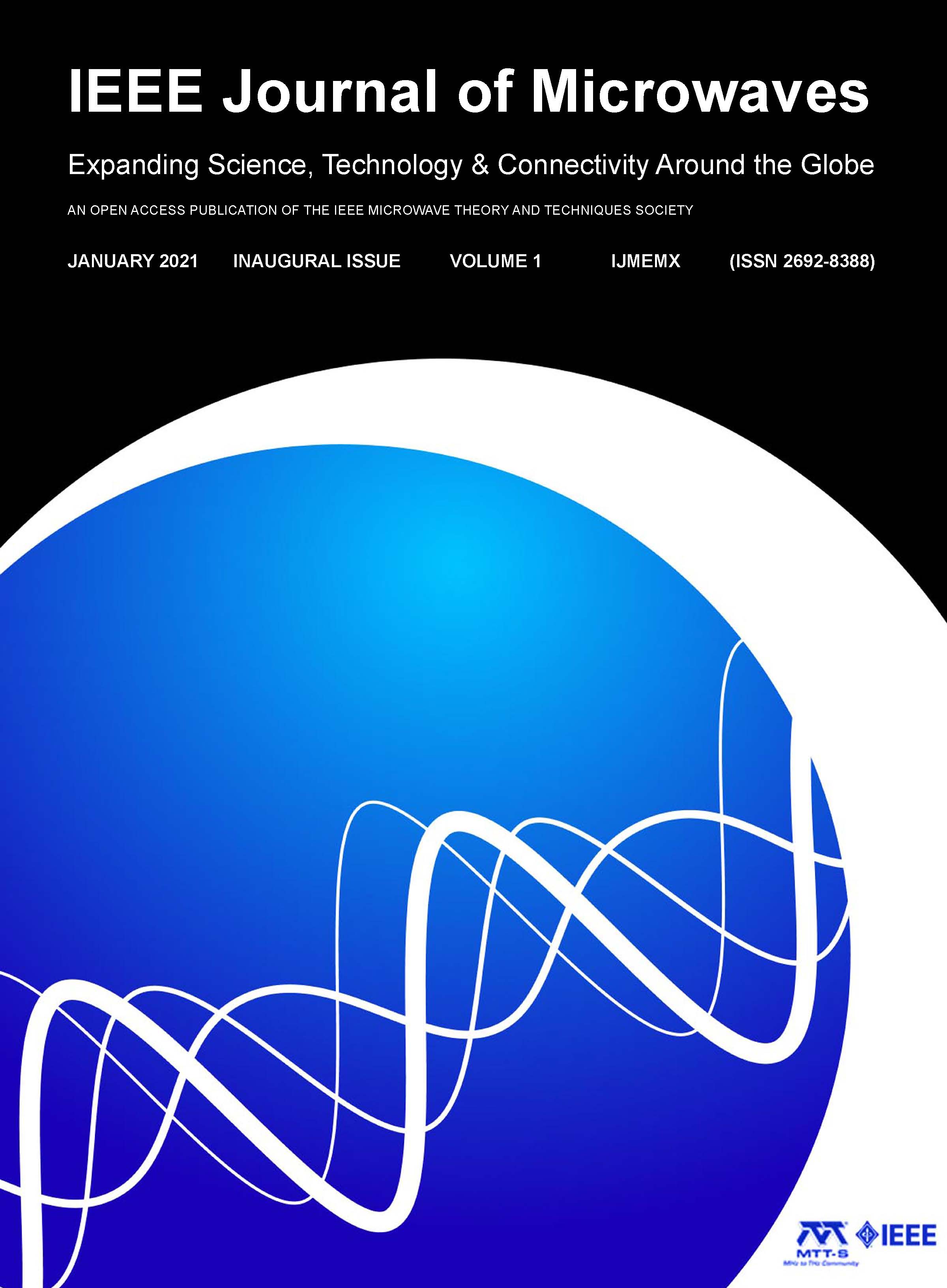
In January 2021 we released a new journal
covering the entire field of microwave science,
technology and applications:
IEEE Journal of Microwaves
In addition to high quality research articles, the new
journal is slated to have a number of special editorial
features including:
Microwave Pioneers: A series of Interview
articles on Notable Contributors to Microwave Science
and Technology
Industry Pioneers: Interviews with Corporate Innovators
in Microwave Applications
Breakthroughs in Microwaves: Interview pieces on current
high impact research and individuals
Microwaves are Everywhere: A Series Highlighting the
Applications of Microwaves and Where and How They Impact
our Lives
Women in Microwaves: A special interview series with
prominent women contributors to our field
Special Introduction to the Journal
Get
our new MTT 70th Anniversary Special Issue - just
released
LINK TO: INAUGURAL ISSUE: Vol. 1, Issue 1, January 2021
RANKED #3 of 278 IEEE Journals for downloads/article published in our first year!
2023 Web of Science Impact Factor of 6.9
2024 Scopus CiteScore = 14.8
GET OUR SPECIAL ISSUE ON:
"MICROWAVES
IN CLIMATE CHANGE"
Background and Philosophy: Dr. Siegel’s research specializes in the invention, development and delivery of a wide range of specialized sensor and source devices, components, and instruments spanning the frequency range between 30 and 10,000 GHz which includes the millimeter, submillimeter and far infrared wavelength regimes: the terahertz bands. Emphasis is placed on a cross disciplinary approach which brings together a diverse range of backgrounds and skills that can be directly applied towards progress in bridging the electronic and optical regimes, one of the last remaining technology gaps in the electromagnetic spectrum. Students and staff working with Dr. Siegel have included electrical engineers, physicists, biologists and chemists from a wide range of backgrounds and countries. Research work has been conducted both at Caltech and at the nearby Jet Propulsion Laboratory, where the emphasis is on Earth, space science and planetary applications of THz technology. Dr. Siegel has recently founded a small international consulting company, THz Global, through which he is continuing his THz research work in collaboration with an international team of colleagues with expertise that spans the full range of millimeter and submillimeter wave applications.
Over a 26 year period, Dr. Siegel and his Submillimeter Wave Advanced Technology
team at JPL and Caltech developed and delivered
critical sensor hardware for four space flight missions:
NASA’s Upper
Atmospheric Research Satellite Microwave Limb Sounder,
the first instrument to directly measure the
anti-correlation between chlorine monoxide build up and
ozone depletion on a global scale; NASA’s Earth
Observing System Aura Microwave Limb Sounder measuring
a wide range of stratospheric molecular species involved
in ozone depletion, global water distribution, climate
change and pollution monitoring across the Earth and
carrying the first THz heterodyne radiometer in space -
2.5 THz OH and water line receiver; the European
Space Agency’s Microwave Instrument on the Rosetta
Orbiter (MIRO), that rendezvoused with comet
Churyumov-Gerasimenko and that measured nuclear
temperature and out gassing rates of carbon monoxide,
water, ammonia and methanol; and most recently the
Heterodyne Instrument for the Far Infrared (HIFI) on the
European Space Agency’s Herschel
Space Telescope, an extremely successful
astrophysics mission recording thousands of molecular
signatures between 300 and 1900 GHz in and around star
forming regions and in external galaxies, to better
understand the composition and evolution of the universe.
In addition to Earth, planetary and space science, Dr.
Siegel is interested in terrestrial applications of
terahertz imaging and spectroscopy and has been actively
pursuing several related initiatives in the health and
biological sciences at Caltech
as well as defense and security applications at both Caltech and JPL. The very
first National
Institute of Health program in the terahertz field,
granted to Dr. Siegel in 2002, had the goal of developing
high signal-to-noise imaging and spectroscopy instruments
for disease diagnostics. A second THz NIH program to
develop low loss terahertz waveguide for endoscopy
applications has also been completed. Additional work on
the thermal and non- thermal effects of millimeter and
submillimeter-wave radiation on cellular systems was
started in 2008. This work was undertaken in conjunction
with the Caltech
biology division and a neurophysiologist,
Dr. Victor Pikov, then at the Huntington Medical Research
Institute in Pasadena, California. Significant expansion
of the biological science work at Caltech included work
on rats, leeches, zebra fish and oocytes to look at low
power millimeter-wave stimulation and control of neuronal
responses, which included a collaboration with Francisco
Bezanilla and Michael Priest at Univ. of Chicago and
Mikhail Shapiro, now at Caltech. Most recently work has
focused on the use of millimeter waves for direct medical
applications. Three ongoing tasks include non-invasive
glucose monitoring using millimeter-wave transmission;
non-invasive determination of blood bag spoilage (a
collaboration with Yuri Feldman and colleagues at Hebrew
University); a program to incorporate and utilize
millimeter-wave hyperthermia in a commercial MRI system (a
past collaboration with HMRI), and a new program to look
at effects of 5G frequencies on tissue heating, with Dr.
David Gultekin at Columbia University.
Facilities:
Dr. Siegel is now working out of a small laboratory in La Canada, CA - THz Global - where he has a well-equipped bio-RF facility with epi-fluorescence inverted and upright microscopes, incubators and cell cultivation and measurement systems, and a wide range of RF electronic and mechanical design, assembly and applications components and instruments. Dr. Siegel regularly accesses and frequently consults with former colleagues and friends from the JPL Submillimeter-Wave Advanced Technology team, which he founded in 1992, and which is currently managed by Dr. Imran Mehdi.
As of December 2023, Dr. Siegel became a founding member
of Cover AI,
a start up company that is currently developing a
state-of-the-art THz imaging radar system for unobtrusive
hidden weapons screening in K-12 school systems. As part
of this effort, Dr. Siegel set up and maintains a 1200 sq.
ft. THz development and test facility in Pasadena where
the Cover system is being developed.
Recent and review papers describing current work:
- J.
W. Waters and P. H. Siegel, "Observing the
Stratospheric Submillimeter Spectrum for Detecting
Threats to the Ozone Layer," in IEEE Journal of
Microwaves, vol. 4, no. 4, pp. 791-835, Oct. 2024,
doi: 10.1109/JMW.2024.3479080.
- P.
H. Siegel, "Introduction to the Special Issue on
Microwaves in Climate Change," in IEEE Journal of
Microwaves, vol. 4, no. 4, pp. 779-790, Oct. 2024,
doi: 10.1109/JMW.2024.3485474.
- J.
W. Waters et al., "A Conical-Scanning Microwave Limb
Sounder for Atmospheric Measurements," in IEEE Journal
of Microwaves, vol. 4, no. 4, pp. 836-846, Oct. 2024,
doi: 10.1109/JMW.2024.3484352.
- Ronnie
S. Siegel and Peter H. Siegel, "Making Waves:
Microwaves in Climate Change, Journal of Microwaves,
vol. 3, no. 3, pp. 863-880, July 2023.
- Peter H. Siegel, "Microwaves are Everywhere, "SMM: nano-Microwaves," IEEE Journal of Microwaves, vol. 1, no. 4, pp. 838-852, Oct. 2021.
- Peter H. Siegel, "Microwaves are Everywhere, "Do You Know Where Your Pet Is?," IEEE Journal of Microwaves, vol. 1, no. 3, pp. 679-688, July 2021.
- Peter H. Siegel, "Microwaves are Everywhere, Ovens: From Magnetrons to Metamaterials," IEEE J. Microwaves, vol. 1, no 2., pp. 523-31, April 2021.
- Peter H. Siegel, "Microwaves are Everywhere, CMB Hiding in Plain Sight," IEEE Journal of Microwaves, vol. 1, no. 1, pp. 14-24, Jan. 2021.
- David H. Gultekin and Peter H. Siegel, "Absorption of 5G Radiation in Brain Tissue as a Function of Frequency, Power and Time," IEEE Access, vol. 8, pp. 115593-115612, 2020. DOI 10.1109/ACCESS.2020.3002183
- Peter H. Siegel, Adrian Tang, Rod Kim, Gabriel Virbila, Frank Chang and Victor Pikov, "Noninvasive In Vivo Millimeter-Wave Measurements of Glucose: First Results in Human Subjects," 2017 International Conference on Infrared, Millimeter, and Terahertz Waves, Cancun, Mexico, Aug. 27-Sept. 1, 2017.
- Peter H. Siegel, Wangde Dai, Robert A. Kloner, Marie Csete and Victor Pikov, "First Millimeter-Wave Animal In Vivo Measurements of L-Glucose and D-Glucose: Further Steps Towards a Non-Invasive Glucometer," 2016 International Conference on Infrared, Millimeter, and Terahertz Waves, W4A.1, Copenhagen, Denmark, Sept. 25-30th, 2016.
- Sergii Romanenko, Peter H. Siegel, Victor Pikov, Vincent Wallace, "Alterations in Neuronal Action Potential Shape and Spiking Rate Caused by Pulsed 60 GHz Millimeter Wave Radiation," 2016 International Conference on Infrared, Millimeter, and Terahertz Waves, H5P.02.06, Copenhagen, Denmark, Sept. 25-30th, 2016.
- Peter H. Siegel, Adrian Tang, Gabriel Virbila, Y. Kim, M.C.F. Chang and Victor Pikov, "Compact non-invasive millimeter-wave glucose sensor," 2015 International Conference on Infrared, Millimeter, and Terahertz Waves, F1D, Hong Kong, China, Aug. 23-28, 2015.
- Peter H. Siegel, Yoon Lee and Victor Pikov, "Millimeter-Wave Non-Invasive Monitoring of Glucose in Anesthetized Rats," 2014 International Conference on Infrared, Millimeter, and Terahertz Waves, T2/D-8.10, Tucson, AZ, USA, Sept. 14-19, 2014.
- Sergii Romanenko, Peter H. Siegel, Daniel A. Wagenaar, and Victor Pikov, "Effects of millimeter wave irradiation and equivalent thermal heating on the activity of individual neurons in the leech ganglion," Journal of Neurophysiology, v. 112, pp. 2423-31, Nov. 2014.
- Mikhail G. Shapiro, Michael F. Priest, Peter H. Siegel, and Francisco Bezanilla, "Thermal Mechanisms of Millimeter Wave Stimulation of Excitable Cells," Biophysical Journal, vol. 104, pp. 2622-28, June 2013. Published Supplementary Materials
- Peter H. Siegel and Victor Pikov, "Impact of low intensity millimetre waves on cell functions," Electronics Letters Special Supplement, v.46, no. 26, pp. S70-72, Dec. 2010
- Peter H. Siegel and Victor Pikov, “THz in Biology and Medicine: Towards Quantifying and Understanding the Interaction of Millimeter- and Submillimeter-Waves with Cells and Cell Processes,” 2010 SPIE Photonics West, BiOS, San Francisco, CA, paper 7562-17, Jan 2010. Invited Keynote
- V. Pikov, X. Arakaki, M. Harrington, S.E. Fraser and P.H. Siegel, “Modulation of neuronal activity and plasma membrane properties with low-power millimeter waves in organotypic cortical slices,” Special Issue of Journal of Neural Engineering, v. 7, no. 4, 045003, August 2010.
- Victor Pikov and Peter H. Siegel , “Thermal Monitoring: Remote Temperature Monitoring of Cells Exposed to Millimeter-Wave Radiation using Microscopic Raman Spectroscopy,” IEEE Engineering in Medicine and Biology Magazine, Jan/Feb 2010, pp. 63-71.
- Ken B. Cooper, Robert J. Dengler, Nuria Llombart, Ashit Talukder, Anand V. Panangadan, Chris S. Peay, Imran Mehdi, Peter H. Siegel, “Fast, high-resolution terahertz radar imaging at 25 meters,” Proc. SPIE v. 7671, 2010.
- Nuria Llombart, Agnese Mazzinghi, Peter H Siegel and Angelo Freni, "Design of a Low Loss Metallo-Dielectric EBG Waveguide at Submillimeter Wavelengths," IEEE Microwave and Wireless Component Letters, v. 19, no.7, July 2009, pp. 437-439.
- K.B. Cooper, R. J. Dengler, G. Chattopadhyay, E. Schlecht, A. Skalare, I. Mehdi and P. H. Siegel, “Penetrating 3-D Imaging at 4- and 25-m Range Using a Submillimeter-Wave Radar ,”IEEE Microwave Theory and Techniques, v.56, no.12, pp. 2771-8, Dec 2008.
- P.H. Siegel, “THz Instruments for Space,” IEEE Transactions on Antennas and Propagation, v. 55, no. 11, pp. 2957-65, Nov 2007.
- P.H. Siegel and R.J. Dengler, “Terahertz Heterodyne Imaging: Instruments,” Int. Journal of Infrared and Millimeter Waves, v.27, no. 5, pp. 631-656, May 2006.
- P.H. Siegel and R.J. Dengler, “Terahertz Heterodyne Imaging: Introduction and Techniques,” Int. Journal of Infrared and Millimeter Waves, v.27, no. 4, April 2006.
- J.W. Waters, L. Froidevaux, R.S. Harwood, R.F. Jarnot, H.M. Pickett, W.G. Read, P.H. Siegel, et.al., “The Earth Observing System Microwave Limb Sounder (EOS MLS) on the Aura satellite,” IEEE Trans. Geoscience and Remote Sensing, v. 44, no. 5, pp. 1075-1092, May 2006. One of Sci-Bytes most highly cited papers
- Harish M. Manohara, Eric Wong, Erich Schlecht, Brian
D. Hunt, P. H. Siegel, “Carbon Nanotube
Schottky Diodes Using Ti-Schottky and Pt-Ohmic
Contacts for High Frequency Applications,”
Nanoletters, vol. 5, no. 7, pp. 1469-1474, 2005.
- C. Yeh, F. Shimabukuro, P.H. Siegel, “Low Loss Terahertz Ribbon Waveguides,” Applied Optics, v. 44, no. 28, pp. 5937-46, Oct. 2005.
- P.H. Siegel, “THz Technology in Biology and Medicine,” IEEE Trans. Microwave Theory and Techniques, vol. 52, no. 10, pp. 2438-2448, Oct. 2004.
- A. Barkan, F. K. Tittel, D. M. Mittleman, R. Dengler, P. H. Siegel, G. Scalari, L. Ajili, J. Faist, H. E. Beere, E. H. Linfield, A. G. Davies, D. A. Ritchie, “Linewidth and tuning characteristics of terahertz quantum cascade lasers,” Optics Letters, v. 29, no. 6, pp. 575-577, March 2004.
- P.H. Siegel, “THz Technology,” IEEE Trans. Microwave Theory and Techniques 50th Anniversary Issue, vol. 50, no. 3, pp. 910-928, March 2002. Special Invited paper.
- Michael C. Gaidis, H.M. Pickett, C.D. Smith, R.P. Smith, S.C. Martin and P.H. Siegel “A 2.5 THz Receiver Front-End for Spaceborne Applications,” IEEE Transactions Microwave Theory and Techniques,MTT-48, no. 4, April 2000, 733-739.
- P.H. Siegel, R.P. Smith, S. Martin and M. Gaidis, “2.5 THz GaAs
Monolithic Membrane-Diode Mixer”, IEEE
Transactions Microwave Theory and Techniques, vol. 47,
no. 5, pp. 596-604, May 1999.
Special THz Pioneer Series Articles from IEEE Transactions on Terahertz Science and Technology and the new IEEE Journal of Microwaves
This series of technical articles highlights the careers of individuals who have made significant long term contributions to the field of microwave science and applications. They appear chronologically as special editorial features in each issue of the IEEE Journal of Microwaves beginning in January 2021. Enjoy their wisdom and their insights!
ALL OF THESE ARTICLES are now being archived at the IEEE ORAL HISTORY project site, part of the Wiki Engineering and Technology History pages: https://ethw.org/Archives:THz_and_Microwave_Pioneers
IF YOU WISH TO VIEW OR DOWNLOAD THE PDF's of these articles, they are all open access and free but you need to create an account on IEEE Xplore - if you do not already have one. The account is free and access to the PDF's will be granted once you have logged in.
Peter H. Siegel, “Microwave Pioneers: John C. Mather ‘A Singular Purpose’,” IEEE Journal of Microwaves, vol. 1, no. 1, pp. 25-31, Jan. 2021.
https://ieeexplore.ieee.org/stamp/stamp.jsp?tp=&arnumber=9206028Peter H. Siegel, “Carver Mead: ‘It’s All About Thinking, A Personal Account Leading up to the First Microwave Transistor,” IEEE Journal of Microwaves, vol. 1, no. 1, pp. 269-274, Jan. 2021.
https://ieeexplore.ieee.org/stamp/stamp.jsp?tp=&arnumber=9318748Peter H. Siegel, "Microwave Pioneers: Charles Elachi, Dare Mighty Things," IEEE. Journal of Microwaves, vol. 2, no 1., pp. 13-22, Jan. 2022.
Peter H. Siegel, "IEEE President K.J.Ray Liu, Follow Multiple Paths, Changing the World with Microwave Time Reversal Focusing," IEEE. Journal of Microwaves, vol. 2, no 3., pp. 360-73, Jly. 2022
Peter H. Siegel, "Microwave Pioneers: Mau-Chung Frank Chang, “The Power of Connections”," IEEE. Journal of Microwaves, vol. 5, no 1., pp. 14-22, Jan. 2025This series of technical articles (in time sequence starting in Sept. 2011 and running through the end of the author's tenure as Editor-in-Chief in December 2015) highlight the careers of individuals who have made significant long term contributions to the field of Terahertz Science and Technology. They appear as the lead articles in each issue of the IEEE Transactions on Terahertz Science and Technology. Read the INTRO page first then move on to the main article. They are also archived on the IEEE Oral History site: https://ethw.org/Archives:THz_and_Microwave_Pioneers
-
IF YOU WISH TO VIEW OR DOWNLOAD THE PDF's of any of these articles, they are all open access and free, but you need to create an account on IEEE Xplore - if you do not already have one. The account is free and access to the PDF's will be granted once you have logged in.
Enjoy their wisdom and their insights!
INTRO TO TERAHERTZ PIONEERS: David H. Auston
https://ieeexplore.ieee.org/stamp/stamp.jsp?tp=&arnumber=6005344
Peter H. Siegel, “THz Pioneers: David H. Auston: Working Collectively to Combine Complementary Knowledge, Perspectives and Talents,” IEEE Trans. on Terahertz Science and Technology, vol. 1, no.1, pp. 5-8, Sept. 2011.
https://ieeexplore.ieee.org/stamp/stamp.jsp?tp=&arnumber=6005343INTRO TO TERAHERTZ PIONEERS: Paul L. Richards
https://ieeexplore.ieee.org/stamp/stamp.jsp?tp=&arnumber=6047824
Peter H. Siegel, “THz Pioneers: Paul L. Richards: Working at the Edge - Transition Edge Sensors and the Edge of the Universe,” IEEE Trans. on Terahertz Science and Technology, vol. 1, no. 2, pp. 341-348, Nov. 2011.
https://ieeexplore.ieee.org/stamp/stamp.jsp?tp=&arnumber=6047825INTRO TO TERAHERTZ PIONEERS: Maurice F. Kimmitt
https://ieeexplore.ieee.org/stamp/stamp.jsp?tp=&arnumber=6112701
Peter H. Siegel, “THz Pioneers: Maurice F. Kimmitt: A Person Who Makes Things Work,” IEEE Trans. on Terahertz Science and Technology, vol. 2, no. 1, pp. 5-9, Jan. 2012.
https://ieeexplore.ieee.org/stamp/stamp.jsp?tp=&arnumber=6119244INTRO TO TERAHERTZ PIONEERS: Robert W. Wilson
https://ieeexplore.ieee.org/stamp/stamp.jsp?tp=&arnumber=6155748
Peter H. Siegel, “THz Pioneers: Robert W. Wilson: The Foundations of THz Radio Science,” IEEE Trans. on Terahertz Science and Technology, vol. 2., no. 2, pp. 161-166, March 2012.
https://ieeexplore.ieee.org/stamp/stamp.jsp?tp=&arnumber=6155749INTRO TO TERAHERTZ PIONEERS: Richard J. Saykally
https://ieeexplore.ieee.org/stamp/stamp.jsp?tp=&arnumber=6189377
Peter H. Siegel, “THz Pioneers: Richard J. Saykally: Water, Water Everywhere... ,” IEEE Trans. on Terahertz Science and Technology, vol. 2, no. 3, pp. 265-270, May 2012.
https://ieeexplore.ieee.org/stamp/stamp.jsp?tp=&arnumber=6189378INTRO TO TERAHERTZ PIONEERS: Daniel R. Grischkowsky
https://ieeexplore.ieee.org/stamp/stamp.jsp?tp=&arnumber=6222359
Peter H. Siegel, “THz Pioneers: Daniel R. Grischkowsky: We Search for Truth and Beauty,” IEEE Trans. on Terahertz Science and Technology, vol. 2, no.4, pp.377-382, July 2012.
https://ieeexplore.ieee.org/stamp/stamp.jsp?tp=&arnumber=6224204INTRO TO TERAHERTZ PIONEERS: Thomas G. Phillips
https://ieeexplore.ieee.org/stamp/stamp.jsp?tp=&arnumber=6287629
Peter H. Siegel, “THz Pioneers: Thomas G. Phillips: The Sky Above, the Mountain Below,” IEEE Trans. on Terahertz Science and Technology, vol. 2, no. 5, pp. 477-484, Sept. 2012.
https://ieeexplore.ieee.org/stamp/stamp.jsp?tp=&arnumber=6287045INTRO TO TERAHERTZ PIONEERS: Frank C. DeLucia
https://ieeexplore.ieee.org/stamp/stamp.jsp?tp=&arnumber=6359818
Peter H. Siegel, “THz Pioneers: Frank C. DeLucia: The Numbers Count,” IEEE Trans. on Terahertz Science and Technology, vol. 2, no. 6, pp. 577-583, Nov. 2012.
https://ieeexplore.ieee.org/stamp/stamp.jsp?tp=&arnumber=6357276INTRO TO TERAHERTZ PIONEERS: Federico Capasso
https://ieeexplore.ieee.org/stamp/stamp.jsp?tp=&arnumber=6423872
Peter H. Siegel, “THz Pioneers: Federico Capasso: Physics by Design: Engineering Our Way Out of the THz Gap,” IEEE Trans. on Terahertz Science and Technology, vol. 3, no. 1, pp. 5-13, Jan. 2013.
https://ieeexplore.ieee.org/stamp/stamp.jsp?tp=&arnumber=6423873INTRO TO TERAHERTZ PIONEERS: Koji Mizuno
https://ieeexplore.ieee.org/stamp/stamp.jsp?tp=&arnumber=6466420
Peter H. Siegel, “THz Pioneers: Koji Mizuno: 50 Years in Submillimeter-Waves: From Otaku to Sensei,” IEEE Trans. on Terahertz Science and Technology, vol. 3, no. 2, pp. 129-133, March 2013.
https://ieeexplore.ieee.org/stamp/stamp.jsp?tp=&arnumber=6466421INTRO TO TERAHERTZ PIONEERS: Manfred and Brenda Pruden Winnewisser
https://ieeexplore.ieee.org/stamp/stamp.jsp?tp=&arnumber=6510004
Peter H. Siegel, “THz Pioneers: Manfred and Brenda Pruden Winnewisser: Equating Hamiltonians to Nature,” IEEE Trans. on Terahertz Science and Technology, vol. 3, no. 3, pp. 228-236, May 2013.
https://ieeexplore.ieee.org/stamp/stamp.jsp?tp=&arnumber=6510011INTRO TO TERAHERTZ PIONEERS: Philippe Goy
https://ieeexplore.ieee.org/stamp/stamp.jsp?tp=&arnumber=6517891
Peter H. Siegel, “THz Pioneers: Philippe Goy: If You Agree with the Majority You Might be Wrong,” IEEE Trans. on Terahertz Science and Technology, vol. 3, no. 4, pp. 347-353, July 2013.
https://ieeexplore.ieee.org/stamp/stamp.jsp?tp=&arnumber=6519341INTRO TO TERAHERTZ PIONEERS: Fritz Keilmann
https://ieeexplore.ieee.org/stamp/stamp.jsp?tp=&arnumber=6588634
Peter H. Siegel, “THz Pioneers: Fritz Keilmann: RF Biophysics: From Strong Field to Near Field,” IEEE Trans. on Terahertz Science and Technology, vol. 3, no. 5, pp. 505-514, Sept. 2013.
https://ieeexplore.ieee.org/stamp/stamp.jsp?tp=&arnumber=6588304INTRO TO TERAHERTZ PIONEERS: Sir John Pendry
https://ieeexplore.ieee.org/stamp/stamp.jsp?tp=&arnumber=6657771
Peter H. Siegel, “THz Pioneers: Sir John Pendry: Theoretical Physics for a Practical World,” IEEE Trans. on Terahertz Science and Technology, vol. 3, no. 6, pp. 689-698, Nov. 2013.
https://ieeexplore.ieee.org/stamp/stamp.jsp?tp=&arnumber=6661403
INTRO TO TERAHERTZ PIONEERS: Shenggang Liu
https://ieeexplore.ieee.org/stamp/stamp.jsp?tp=&arnumber=6710212
Peter H. Siegel, “THz Pioneers: Shenggang Liu: China's Father of Vacuum and Microwave Electronics,” IEEE Trans. on Terahertz Science and Technology, vol. 4, no.1, pp. 5-11, Jan. 2014.
https://ieeexplore.ieee.org/stamp/stamp.jsp?tp=&arnumber=6710209INTRO TO TERAHERTZ PIONEERS: Mattheus (Thijs) de Graauw
https://ieeexplore.ieee.org/stamp/stamp.jsp?tp=&arnumber=6759793
Peter H. Siegel, “THz Pioneers: Mattheus (Thijs) de Graauw: Intention, Attention, Execution,” IEEE Trans. on Terahertz Science and Technology, vol. 4, no. 2, pp. 137-146, Mar. 2014.
https://ieeexplore.ieee.org/stamp/stamp.jsp?tp=&arnumber=6759780INTRO TO TERAHERTZ PIONEERS: Tatsuo Itoh
https://ieeexplore.ieee.org/stamp/stamp.jsp?tp=&arnumber=6807841
Peter H. Siegel, “THz Pioneers: Tatsuo Itoh: Transmission Lines and Antennas: Left and Right,” IEEE Trans. on Terahertz Science and Technology, vol. 4. no. 3, pp. 297-306, May 2014.
https://ieeexplore.ieee.org/stamp/stamp.jsp?tp=&arnumber=6807864INTRO TO TERAHERTZ PIONEERS: Michael Bass
https://ieeexplore.ieee.org/stamp/stamp.jsp?tp=&arnumber=6839054
Peter H. Siegel, “THz Pioneers: Michael Bass: The THz Light at the End of the Tunnel,” IEEE Trans. on Terahertz Science and Technology, vol. 4. no. 4, pp. 409-417, July 2014.
https://ieeexplore.ieee.org/stamp/stamp.jsp?tp=&arnumber=6828793INTRO TO TERAHERTZ PIONEERS: Erik Kollberg
https://ieeexplore.ieee.org/stamp/stamp.jsp?tp=&arnumber=6877710
Peter H. Siegel, “THz Pioneers: Erik Kollberg: Instrument Maker to the Stars,” IEEE Trans. on Terahertz Science and Technology, vol.4 no. 5, pp. 537-544, Sept. 2014.
https://ieeexplore.ieee.org/stamp/stamp.jsp?tp=&arnumber=6877752INTRO TO TERAHERTZ PIONEERS: Robert J. Mattauch
https://ieeexplore.ieee.org/stamp/stamp.jsp?tp=&arnumber=6930852
Peter H. Siegel, “THz Pioneers: Robert J. Mattauch: Two Terminals are Sufficient,” IEEE Trans. on Terahertz Science and Technology, vol. 4, no. 6, pp. 645-652, Nov. 2014.
https://ieeexplore.ieee.org/stamp/stamp.jsp?tp=&arnumber=6922166INTRO TO TERAHERTZ PIONEERS: Hiromasa Ito
https://ieeexplore.ieee.org/stamp/stamp.jsp?tp=&arnumber=6994831
Peter H. Siegel, “THz Pioneers: Hiromasa Ito: Generating THz Energy is Crystal Clear,” IEEE Trans. on Terahertz Science and Technology, vol. 5, no. 1, pp. 6-13, Jan. 2015.
https://ieeexplore.ieee.org/stamp/stamp.jsp?tp=&arnumber=6994294INTRO TO TERAHERTZ PIONEERS: Jun-ichi Nishizawa
https://ieeexplore.ieee.org/stamp/stamp.jsp?tp=&arnumber=7054005
Peter H. Siegel, “THz Pioneers: Jun-Ichi Nishizawa: THz Shogun,” IEEE Trans. on Terahertz Science and Technology, vol. 5, no. 2, pp. 161-169, Mar. 2015.
https://ieeexplore.ieee.org/stamp/stamp.jsp?tp=&arnumber=7047877INTRO TO TERAHERTZ PIONEERS: Derek H. Martin
https://ieeexplore.ieee.org/stamp/stamp.jsp?tp=&arnumber=7086352
Peter H. Siegel, “THz Pioneers: Derek H. Marin: The Mesh that Helped Ensnare the Cosmic Microwave Background,” IEEE Trans. on Terahertz Science and Technology, vol. 5, no. 3, pp. 325-331, May 2015.
https://ieeexplore.ieee.org/stamp/stamp.jsp?tp=&arnumber=7086350INTRO TO TERAHERTZ PIONEERS: Paul F. Goldsmith
https://ieeexplore.ieee.org/stamp/stamp.jsp?tp=&arnumber=7160804
Peter H. Siegel, “THz Pioneers: Paul F. Goldsmith: New Eyes for THz Astronomers,” IEEE Trans. on Terahertz Science and Technology, vol. 5, no. 4, pp. 529-538, July 2015.
https://ieeexplore.ieee.org/stamp/stamp.jsp?tp=&arnumber=7127064INTRO TO TERAHERTZ PIONEERS: Xi-Cheng Zhang
https://ieeexplore.ieee.org/stamp/stamp.jsp?tp=&arnumber=7230320
Peter H. Siegel, “THz Pioneers: Xi-Cheng Zhang: The Face of THz,” IEEE Trans. on Terahertz Science and Technology, vol. 5, no. 5, pp. 705-714, Sept. 2015.
https://ieeexplore.ieee.org/stamp/stamp.jsp?tp=&arnumber=7208902INTRO TO TERAHERTZ PIONEERS: Joe W. Waters
https://ieeexplore.ieee.org/stamp/stamp.jsp?tp=&arnumber=7335701
Peter H. Siegel, “THz Pioneers: Joe W. Waters: THz Meets Gaia,” IEEE Trans. on Terahertz Science and Technology, vol. 5, no. 6, pp. 862-883, Nov. 2015.
https://ieeexplore.ieee.org/stamp/stamp.jsp?tp=&arnumber=7305833Editorials from IEEE Trans. THz Science and Technology and IEEE Journal of Microwaves
Peter H. Siegel, "Introduction to the Winter 2022 Issue," IEEE J. Microwaves, vol. 2, no. 1, pp. 3-12, Jan. 2022
Peter H. Siegel, "Introduction to the Spring 2022 Issue," IEEE J. Microwaves, vol. 2, no. 2, pp. 230-238, Apr. 2022
Peter H. Siegel, "Introduction to the Summer 2022 Issue," IEEE J. Microwaves, vol. 2, no. 3, pp. 350-359, Jly. 2022
Peter H. Siegel, "Introduction to the Fall 2022 Issue," IEEE J. Microwaves, vol. 2, no. 4, pp. 535-544, Oct. 2022 -
Editorials introducing each issue of IEEE Transactions on Terahertz Science and Technology: Through Nov. 2015
Farewell Editorial - Nov. 2015 -
Honors, Activities
- Founding Editor-in-Chief, IEEE Journal of Microwaves (2020- )
- Founding Editor-in-Chief, IEEE Transactions on Terahertz Science and Technology (2011-15)
- Founding Chair, Int. Society of Infrared, Millimeter, and Terahertz Waves (2009-12)
- Elected General Secretary, Int. Society of Infrared, Millimeter, and Terahertz Waves (2011-present)
- Chair, Kenneth J Button Prize Committee (2014-present)
- Chair IRMMW-THz Hosting Oversight Committee (2017, 2020)
- Chair, IEEE Trans.Terahertz Science and Technology Best Paper Prize (2012-15)
- Vice-Chair/Chair, International Organizing Comm., Int. Conf. IRMMW-THz (2004-2011)
- IEEE Distinguished Microwave Lecturer 2005-2008
- IEEE Speakers Bureau 2009-2014
- IEEE Life Fellow 2001/2020
- IEEE MTTS AdCom member - elected 2020
- IEEE MTTS Microwave Applications Award, 2018
- Vice-Chair/Chair, IEEE Microwave Theory and Techniques Committee 4 - Terahertz Technology (2002-2008)
- Co-Chair, 39th Int. Conf. on Infrared, Millimeter, and Terahertz Waves, Tucson, AZ, Sept. 15-19th, 2014
- Chair, 33rd International Conference on Infrared and Millimeter Waves and 16th International Conference on Terahertz Electronics, Pasadena, CA, Sept. 15-19th, 2008
- Co-Chair, 18th Int. Symposium on Space THz Technology (ISSTT), Pasadena, CA, March 21-23, 2007
- Organizer/Chair of seven Special Technical Sessions on Terahertz Technology and Applications at the IEEE International Microwave Symposium (2000-2007)
- Editorial Board, Journal of Infrared, Millimeter, and Terahertz Waves (JIMT) 2004-2014
- Special Issue Editor, JIMT, "Terahertz for Life," Dec. 2009.
- Special Issue Editor-in-Chief, IEEE Transactions on Microwave Theory and Techniques, "THz Technology: Bridging the Microwave-to-Photonics Gap," July 2010.
- Technical Program Committee, IEEE International Microwave Symposium (2001-2009)
- International Organizing Committee, Int. Symposium on Space THz Technology (1990-2001)
- Exceptional Service Award, Int. Society of Infrared, Millimeter, and Terahertz Waves, 2014
- Chair IEEE Trans. THz Science and Tech. Best Paper Prize Committee (2018/2019)
- Vice-Chair IEEE MTT Fellows Committee (2019)
- Elected member Microwave Theory and Techniques Society Admin. Committee (2020-)
- Ten NASA Group Achievement Awards
- NASA Space Act Award
- More than 75 NASA Certificates of Recognition for Technology Development
- Three-time winner of JPL Award for Technical Excellence (1998, 2000, 2001)
- Four JPL Team Awards for Technical Achievement
- Two JPL Technical Commendation Certificates
- 10 Patents
- More than 30 Keynote and Plenary talks, More than 250 invited international presentations.
- Founder of THz Global, an international consulting group developing THz applications
- Complete
Publications List
Featured in:
ChemMatters, “Peter Siegel: Studying the Energy of the Universe,” an interview article for the American Chemical Society, Sept. 2002, pp. 6-7
NIH e-Advances, “Retooling a Research Career - From Engineering to Biology and Back,” an e-interview for the National Institute of Health, June 2006.
BioOptics World, "Can Neurons Sense Millimeter Waves, a feature article by Barbara Goode, February 2010
Institution of Engineering and Technology, interview and feature supplement article, Electronics Letters, Interview with Dr. Peter Siegel, Dec. 2010
Co-author of Best Paper of the Decade award, Indium Phosphide and Related Materials Conference, 1998
Keynote Lecture and Highlighted Article for an opening exhibit of the National Electronics Museum: “Sir Jagadis Chunder Bose: Traversing the Interdisciplinary Gap Between Physics and Biology,” November 2008.
Founder and author of IEEE Trans. on Terahertz Science and Technology THz Pioneer series: 26 articles to date - one in every issue of the transactions since Sept. 2011.
125 professional staff and student hires
Supervisor of 1 Doctoral, 1 Masters, 2 Senior theses
PI or co-I on 65+ research programs totaling more than $60M spanning 25 years
1000+ pages of technical reports!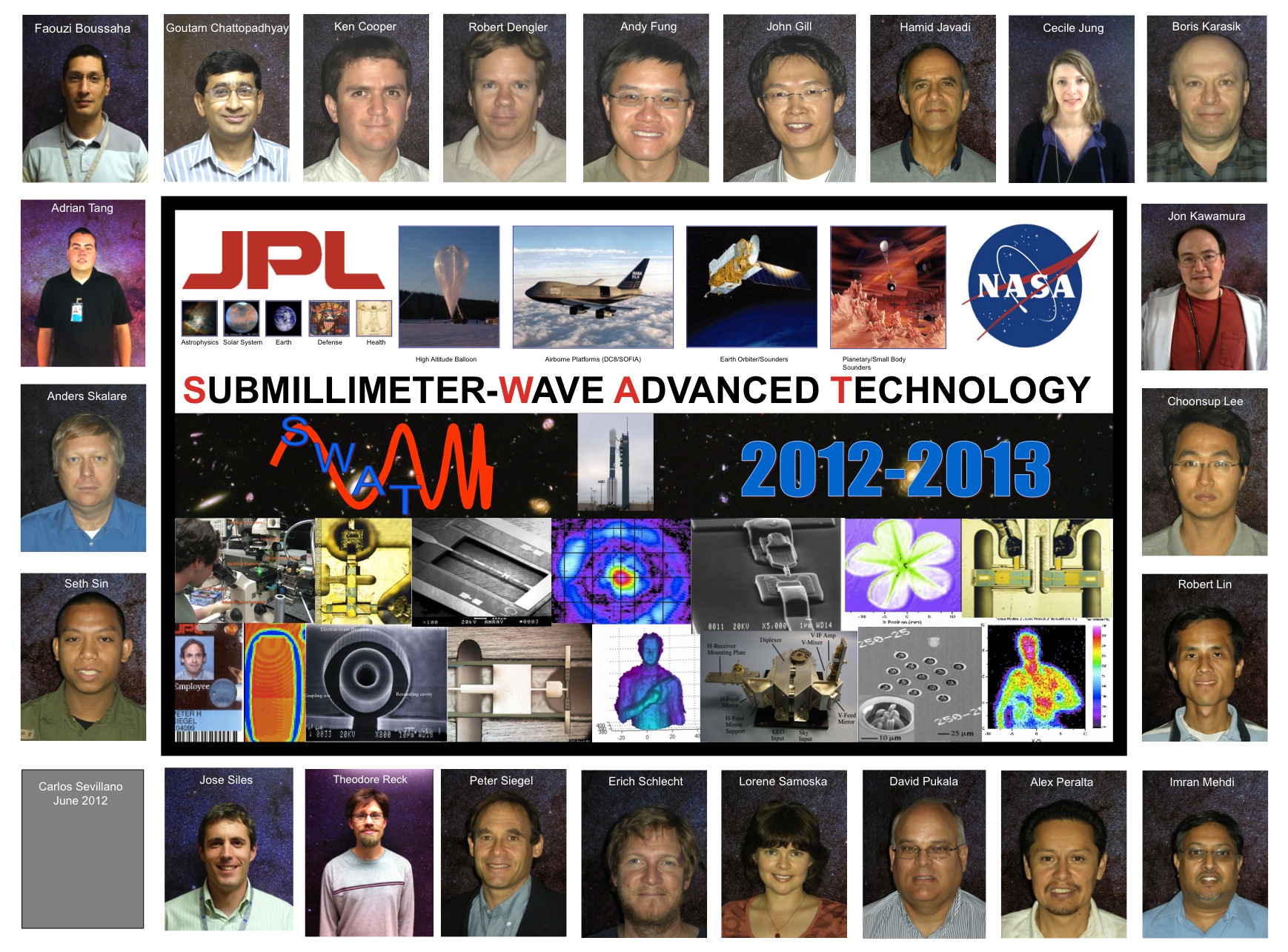
Return to the RF and Microwave Research Group Page.
Go to the homepage of the Department of Electrical Engineering,
Go to the homepage of the Applied Physics Department
California Institute of Technology
Last updated May 2, 2012.
